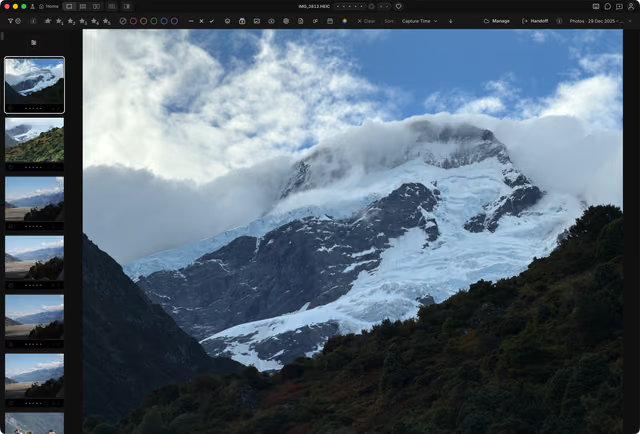
If you're wondering why someone would forgo $200k, dedicate nine months (so far), and try to compete alone in an industry of established players to create the best possible post-shoot photography software, then I would say to you... that's a fair question!
Building Cullibrate has been the opportunity of a lifetime. But it was never the plan.
Where it started
I've always loved photography, but I'm not a professional photographer. Nonetheless, the first software application I ever built was a photo culling app called Stockify. Years later my interest in culling apps was reignited when I joined Narrative. I spent two years there and loved working on that product.
When I left, I had no intention of building more photography software. I did, however, buy a bunch more camera gear, and I started taking a lot of photos of my own. After a long summer holiday of beatific hiking and photo-taking, I sat down to go through them, and I realised I still didn't have a program I truly wanted to use. Nothing I trusted, and nothing with the mix of features I wanted after a shoot.
A whim, then nine months
That moment coincided with AI-assisted software development really taking off. Yes, every man and his dog was "vibe coding". But agentic tools were starting to support serious software engineering.
So on a whim, I asked a software agent to build me something simple. Three days in, I had a working prototype. It was actually pretty good... considering. Under the hood though, the code was terrible, and the app left a lot to be desired.
So I started again, properly. That restart became a project that joyously consumed me. It turned into two obsessions at once: pushing agentic engineering as far as it would go to produce high-quality software at scale, and building the best post-shoot tool I could possibly dream of.
Both veins grew together. My agentic engineering got sharper, and I gained an ever-deeper knowledge of the inner workings of photo formats. I kept working, and the results kept getting better.
At some point it became clear that I could compete with the major players, like Narrative, Aftershoot, Imagen and Photo Mechanic. I could do it at a fraction of the price, with almost no payroll. (I'm not even paying myself 😅)
The photographers
I started reaching out to photographers, and I'm hugely grateful to everyone who has helped Cullibrate along the way. Even the smallest tip-offs sometimes became whole feature sets I realised were critical to a complete solution.
What one person can build
This new age of software development is incredible, but it's more than just software. Being able to build an entire business on your own is a dream come true for anyone who loves making things. In saying that, modern tooling or not, it hasn't been easy. But I can step back and see an application, built by one person, that now competes with companies of 10 to 50 staff. That still completely amazes me.
Yes, every one of those products has its strengths, but Cullibrate has its own too.
Fast is a feature
Cullibrate was built from the ground up with performance in mind. One of the key design goals was that Cullibrate will never show you a blurry placeholder photo on screen, even when moving through photos at pace. Every other photo application in the industry that I know of shows blurry placeholders while loading. Photo Mechanic is probably the best here, and I'll give them props on speed, but I've still seen it there in certain circumstances.
Speed isn't just about photo display, though. It's about every feature of the application, and how fast you can get to where you're going as a photographer. With Cullibrate you can start viewing your photos with predicted edits applied from the moment the first one has copied from your card, within seconds of plugging it in.
A major focus of Cullibrate has been to make all of these aspects feel completely streamlined.
Your choice
Now the story is about the choices you, as photographers, make. The nature of creating software has changed, and to a significant extent the only difference between major-brand software and solid indie options like Cullibrate is marketing. Marketing is actually very important; it creates an emotional connection to the process. With indie software, you get a connection with a very human story. I hope you think that's kind of cool.
So why did I do it?
I built Cullibrate because I wanted it to exist. I also wanted to know if it was possible. And it turns out it is! The benefit is for all photographers: photography software no longer needs to be so expensive.
After a nine-month delay, perhaps I can genuinely begin to cull those photos. Or should I ship that next feature? Maybe I'm just the biggest culling procrastinator of all time. Wouldn't that be ironic? But hey, at least I get it!