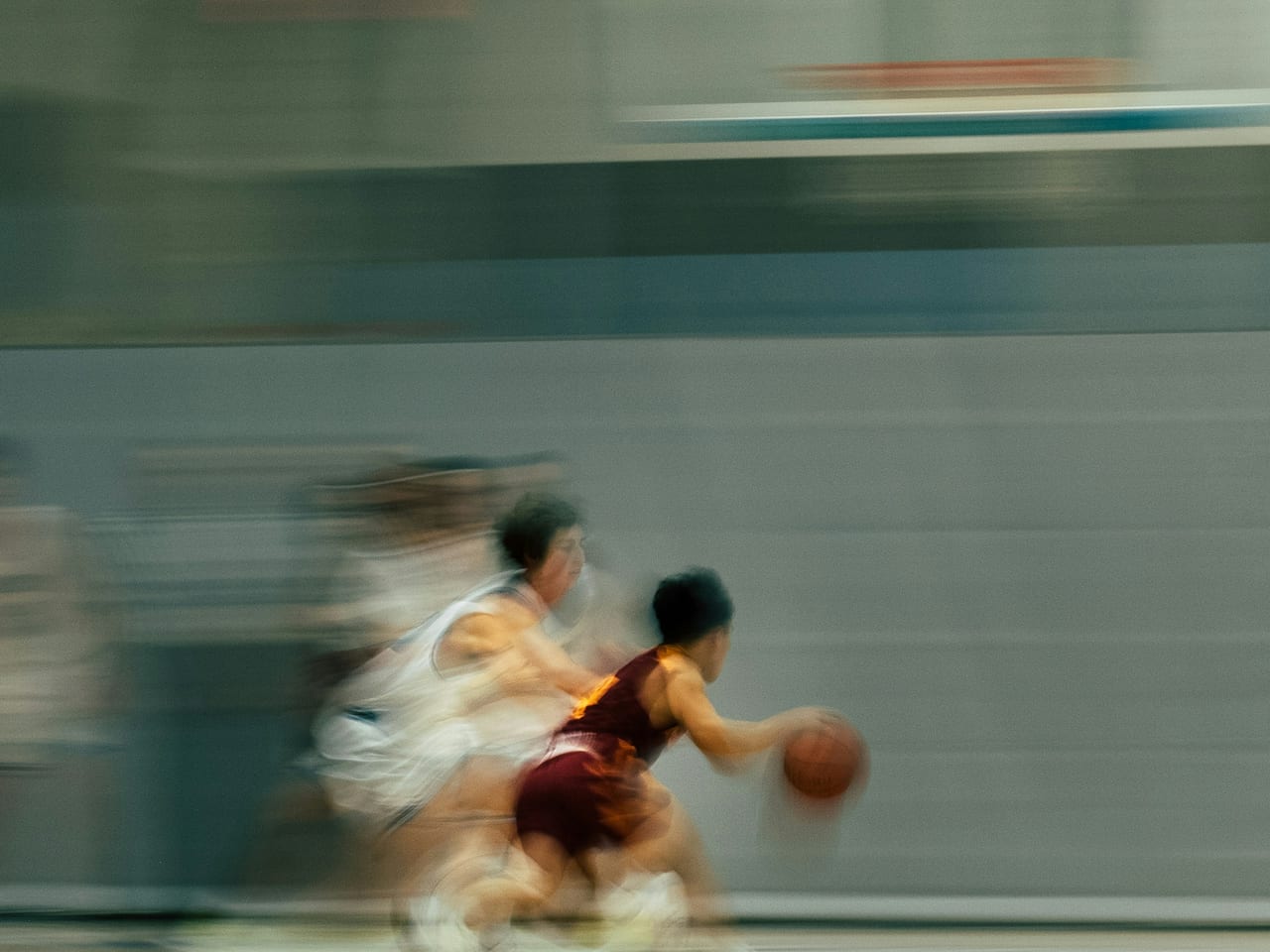
Your camera recorded eighteen frames. Your client did not experience eighteen moments.
A burst is one event sampled repeatedly: the bird leaving the branch, the striker meeting the ball, the child turning into a laugh, the kiss before two faces separate. Review those files as unrelated photographs and you repeat the same decision until your attention gives out.
Do not cull the frames. Cull the change between them.
Find the boundaries first
Before comparing quality, identify where the action begins, changes, and ends. A long sequence may contain several distinct moments: approach, contact, reaction, release. If the story changes, split the burst. If only the milliseconds change, keep it together.
This matters because “choose one” is not always the right instruction. A landing and the celebration after it may deserve separate photographs. Twelve nearly identical frames of the landing do not.
Read the motion before checking the pixels
Move through the group once without rating. Watch what changes: body position, gesture, gaze, spacing, background, obstruction, and the relationship between subjects. You are looking for the hinge—the instant after anticipation becomes action, or action becomes reaction.
The visually strongest frame is often near that hinge, but not by rule. In wildlife, the cleanest wing position may appear before peak height. In sport, the useful frame may need the ball, the face, and the defender in one readable arrangement. In portraiture, the frame after the posed smile can hold the real expression.
Compare the finalists side by side
Promote a small handful on the first read, then compare only those candidates. Hold the zoom level steady so the evidence does not change between frames. Judge them in this order:
- Meaning: which frame makes the action or expression most legible?
- Timing: where does the gesture, impact, or relationship peak?
- Separation: where are subjects least obstructed and the silhouette cleanest?
- Composition: which edges and background relationships create the least friction?
- Focus: among the meaningful candidates, where did the critical detail land?
Focus comes late deliberately. It is a gate, not the author. The sharpest frame in a burst can still be the photograph where nothing has happened yet.
Use reverse culling as a shortcut, not a belief
Photographers often find the later frames in a static portrait or wildlife sequence stronger because they kept shooting while refining distance, timing, or expression. Starting at the end can save time in those sequences. It is a useful bet, not a law. For receding action, the decisive frame may be near the beginning.
Know when one frame is not enough
Keep more than one photograph when the sequence itself changes the meaning: launch and landing, question and reaction, collision and aftermath. Do not keep three frames merely because all three are good. Keep them because each says something the others cannot.
A sequence needs different beats. A duplicate only repeats the beat louder.
When the choice will not resolve
If two finalists remain genuinely equal, keep both and continue. Context from the rest of the set may break the tie later: one orientation fits the layout, one expression is already overrepresented, or one frame completes a sequence. Culling speed disappears when a minor decision demands certainty it cannot yet have.
The tool should preserve context
Fast auto-advance is useful until you need to look back. A burst workflow should keep the group visible, make previous and next immediate, support a fixed comparison, and let you return to the surrounding sequence without losing your selections.
Cullibrate groups similar frames and lets you move between Filmstrip and Survey so the decision can change altitude without losing the moment around it.