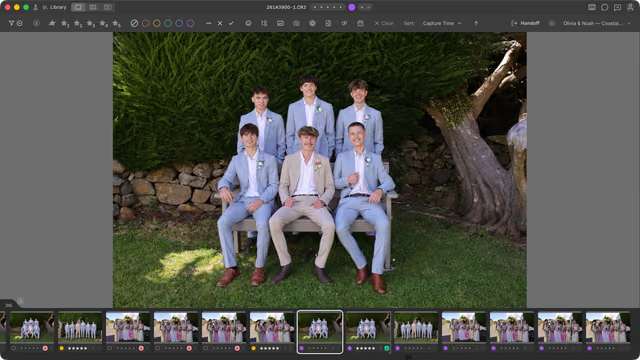
A disclosure before the verdict: I built Cullibrate. This is not an “independent” roundup assembled from feature lists. I have worked on professional culling software, built one of my own, and spent an indecent amount of my life watching photographs render.
So what is the best photo culling software in 2026? My answer is simple.
If you definitely need AI to rank the strongest frame inside every group of similar photographs, are willing to accept a less snappy workspace experience, and are prepared to pay as much as twelve times more at the normal monthly price, choose Narrative. Its Scenes View and First Pass ranking are mature and useful. Cullibrate is not yet as strong at that specific job. However, for a photo-selection workspace, that is about where Narrative’s advantages end.
For nearly everyone else choosing a dedicated culling workspace, Cullibrate is the better buy: the review modes, grouping, face inspection, ratings, filters, file controls, and editing handoff expected from a professional tool, for $29 a year during the founding offer.
The lower price is a consequence of how Cullibrate is built—not an odd apology for what it isn’t.
The 2026 shift: quality and price have come apart
Dedicated photography software has lived in a comfortable professional-price bracket for years. Photo Mechanic currently costs $149 a year. Narrative is $29 a month for the nearest analogous plan. Neither price tells you what a complete culling workspace has to cost in 2026.
Cullibrate’s founding plan is $29 a year. That is less than one fifth of Photo Mechanic’s annual price, and gives you a full year instead of a single month at Narrative’s normal monthly price.
Prices checked against public USD pricing on 26 August 2026. Plans change.
Cullibrate is packed with high-quality features
Beyond feature parity (besides those mentioned above) with Narrative Select, Cullibrate delivers:
- Blended review modes: Survey and Face Survey directly from Loupe, Compare mode, and popover face review in Grid.
- Image scrubbing so fast your bursts look like high-resolution video.
- Direct-to-high-resolution images with no blurred-image-to-thumbnail transition and noticeably faster image display.
- A RAW rendering pipeline that upgrades smaller embedded previews to high-quality review images.
- Video support for mixed media shoots.
- Ingestion from iPhone and cameras for mixed-camera shoots.
- Multilingual support.
- Three workspace themes: Light, Grey, Dark.
- Configurable hosted Client Galleries (alpha in the founding plan).
- ~$211 saved per year.
The workflow begins with the shoot, not the folder
Cullibrate can recognise sessions as they arrive from an SD card, helping turn ingest into the beginning of a shoot-based workflow instead of another folder-management task. Camera photographs, iPhone images, and video can remain part of the same outing rather than becoming separate jobs simply because they came from different devices.
Once the work is inside, the review modes change with the decision. Grid shows the whole shoot. Filmstrip restores the sequence. Survey puts the difficult candidates together. Face Survey finds the blink. Compare settles the final pair. The photograph stays at the centre while the workspace changes around it.
The honest exception: Narrative ranks the room before you enter
Narrative has one advantage I would not wave away: its AI ranking within Scenes. Similar photographs are grouped, assessed for focus, expression, and composition, then rank-ordered so the likely winners appear first. If you routinely open a group of thirty near-identical frames and want the strongest candidates brought to the top, that is valuable.
Cullibrate groups bursts, detects faces, and gives you excellent ways to compare the candidates. Its ranking inside those groups is not yet as strong as Narrative’s.
It comes down to this: is stronger group ranking worth accepting a less snappy review workspace and paying the normal price of a Cullibrate year for a Narrative month?
That’s ultimately up to you, but it is a tradeoff, and locking in the founding plan will give you access to ongoing improvements to Cullibrate as it closes the gaps.
Photo Mechanic solves a different problem
Choose Photo Mechanic if culling is inseparable from newsroom-grade IPTC captioning, code replacements, tethered ingest, and FTP delivery. Its depth in metadata and transmission remains a clear reason to buy it.
If the job is photo selection, the question changes. Do you want a traditional file-and-metadata workflow, or a modern shoot-based workspace with automatic session detection, burst grouping, face detection, mixed-media support, and configurable hosted Client Galleries?
Aftershoot and FilterPixel make a different promise
Choose Aftershoot or FilterPixel if you want software designed to make the initial keeper decisions for you. Cullibrate is photographer-led: its assistance helps organise and inspect the work, while the person who made the photographs keeps responsibility for taste.
Again, the decision is not simply “more AI or less AI.” Do you want AI to perform the cull for you, even if the software is less focused on the human review experience? Or do you want a stronger workspace in which AI assists without taking over?
Where Cullibrate is the winner
Choose Cullibrate when you want to see the work, move through it quickly, compare similar photographs in context, inspect the people who matter, and keep the final judgment yours. That describes a large share of working photographers—and it no longer requires a large annual software bill.
At the founding price, you can use Cullibrate for five years before spending the cost of one year of Photo Mechanic. At Narrative’s normal monthly price, the same $29 buys one month there or one year here. The lower price does not come from removing the professional workspace. It comes from removing the old cost structure behind it.
The 2026 question is no longer “Which expensive culling tool should I buy?” It is “Which advantage would make me leave the better-value workspace?”
The verdict
Narrative wins if stronger within-group AI ranking matters more than the rest of the review experience. Photo Mechanic wins if deep metadata and transmission are part of the cull. Aftershoot or FilterPixel wins if you want the software to make more of the selection for you. Cullibrate wins if you want a fast, fully featured, photographer-led workspace at a price that no longer feels tied to the old category.
The trial lasts seven days and requires no credit card. Give it a difficult real shoot: repeated moments, group photographs, awkward faces, mixed formats, and video. A category claim is worth nothing if the software cannot survive your Monday morning.